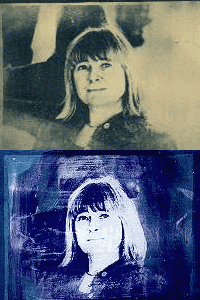
| Biography Agatha’s life was a case of yin/yang as she has always turned to art and creativity for healing and joy in troubled times. She grew up in the violence of World War II in Holland, escaped a strict Protestant background to begin her mixed race family at a young age, survived a traumatic bout of tuberculosis and sanatorium in Northern Ontario in the seventies, and recently recovered from a dangerous form of skin cancer. Yet she remained steadfast and courageous throughout these obstacles, always prolific, inspired and inspiring. She has been influential in a large circle of artists and musicians, using her intuitive teaching methods to encourage others, including her own children who are now also artists. Red Lotus Statement Agatha Schwager’s work, Red Lotus, is inspired by her experiences with Qigong, a form of Chinese exercise and meditation resulting in healing and health. Her life long fascination with the expressive calligraphic brushwork already apparent in Rembrandt’s beautiful drawings and the Dutch drawing tradition, has led her to Oriental brush painting in search of different ways of acquiring these skills. Her exhibition, Red Lotus, contains two sets of Chinese style paintings, the first in colours, the second black and white. The Red Lotus flower series is based on breathing techniques in qigong, the Chi of breathing, inhalation-exhalation. The lotus pure and light is growing out of dark muddy water, rising, floating and expanding, revealing insight and wisdom. The second set of paintings is titled Vitality, here she combines Chinese painting with surrealist techniques as the subject matter, the flowing brush gives her the opportunityto uncover imagery which is mysterious, leaving room for the spectator to perceive the composition and imagine the content. "Ch’i yun may be expressed by ink, by brushwork, by an idea or by an absence of idea . . it is something beyond the feeling of the brush and the effect of ink, because it is the moving power of Heaven, which is suddenly disclosed. But only those who are quiet can understand it." Chang Keng, 18th Century painter Obituary Professional experience |